Norbec Walk In Coolers
n the walk-in cooler market, not every brand earns its reputation the same way. Some become known for aggressive pricing. Some get attention because they are easy to find through dealers. Others build their name through project flexibility, panel quality, and the ability to support real-world commercial installations where layout constraints, energy performance, and long-term durability matter just as much as refrigeration temperature. Norbec belongs in that last category.
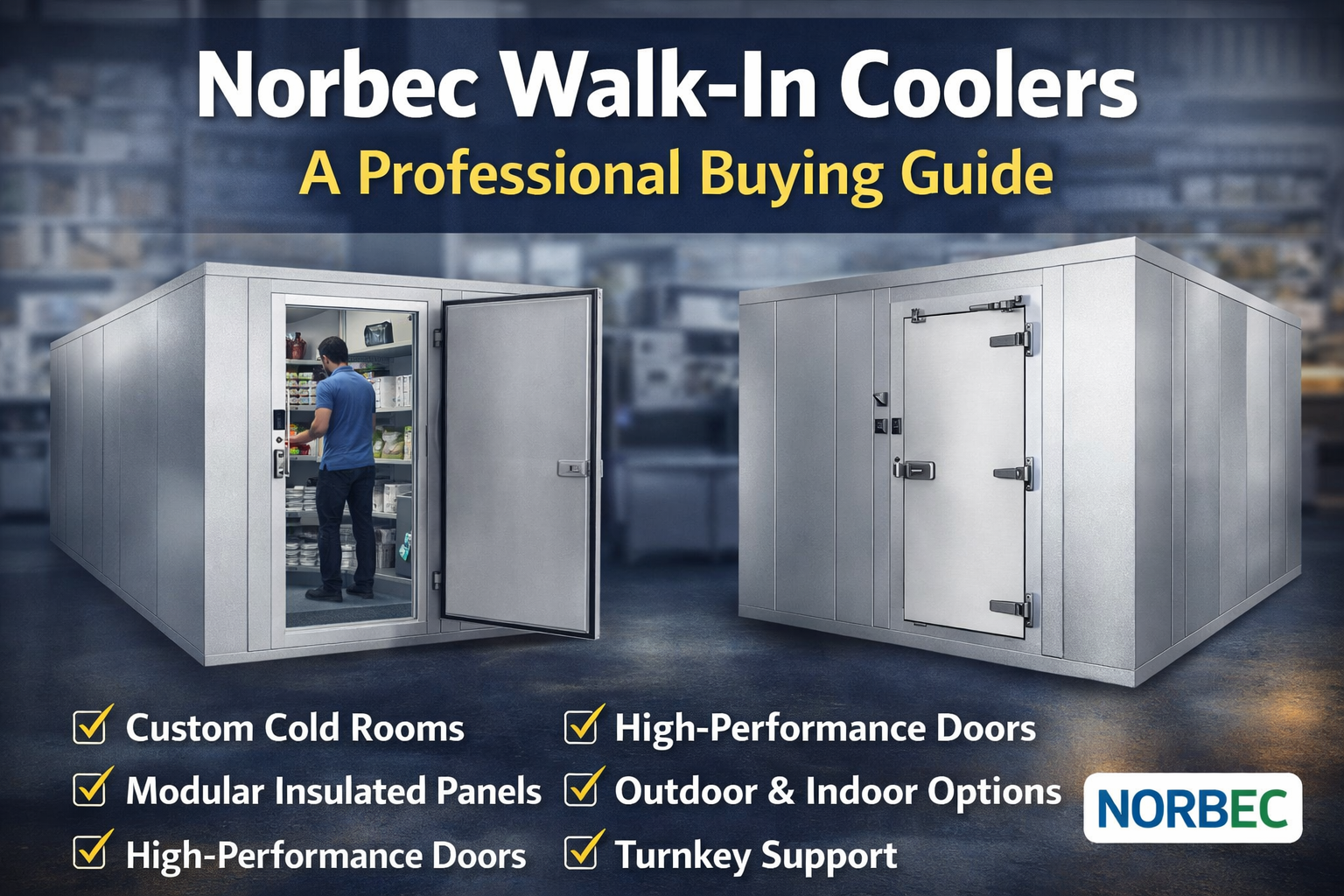
For buyers who are researching walk-in coolers seriously, Norbec is not just another name in prefabricated refrigeration. The company positions itself around custom cold room manufacturing, insulated panels, doors, refrigeration systems, and turnkey support for a wide range of industries. Its official walk-in product structure includes standard walk-in coolers and freezers, custom walk-ins, outdoor walk-ins, camlock panels, high-performance doors, and refrigeration systems, which immediately tells you that Norbec is thinking beyond a simple box sale. It is approaching walk-ins as integrated cold storage systems.
That distinction matters.
A walk-in cooler is rarely just a piece of equipment. In a restaurant, it is part of inventory control, prep organization, and food safety. In grocery and convenience retail, it directly affects merchandising, replenishment, and shrink reduction. In healthcare and pharmaceutical environments, temperature control becomes even more critical. Norbec explicitly identifies restaurants and food service, retail and grocery, healthcare and pharmaceuticals, and industrial use among the major application areas for its walk-in cooler and freezer solutions.
So the real question is not simply whether Norbec makes walk-in coolers. It clearly does. The more important question is this: what kind of buyer is Norbec right for, and what should you understand before choosing a Norbec walk in cooler for your business?
This guide answers that from a practical commercial standpoint.
Why Norbec stands out in the walk-in cooler market
One of the strongest things about Norbec’s positioning is that it does not treat walk-ins like one-size-fits-all products. The company repeatedly emphasizes customization, modular insulated panels, dimensional flexibility, and application-specific solutions. On its custom walk-ins pages and brochures, Norbec explains that its cold rooms are manufactured according to project specifications and designed to maximize the use of available space, including more complex layouts and non-conventional angles.
That is important because many walk-in buyers underestimate how often the building itself dictates the refrigeration solution. A restaurant may have an awkward back-of-house footprint. A market may need to preserve aisle flow. A food production facility may need a walk-in that integrates with larger workflow, sanitation, or expansion plans. A brand that is built around custom panel systems and tailored project design has an advantage in those situations.
Norbec also places substantial emphasis on its panel engineering. Its custom brochure states that its walk-ins use polyurethane core panels with highly resistant camlocks foamed into place. The same literature highlights water- and vapor-proof sealing at panel joints, the elimination of thermal bridges, efficient insulation, and quick installation. Those are not minor details. In the walk-in world, panel integrity, sealing performance, and thermal efficiency affect both long-term operating cost and day-to-day dependability.
This is one reason Norbec tends to appeal to more specification-minded buyers. If you are only shopping by rough size and starting price, you may miss what makes a custom panel-focused manufacturer valuable. But if you care about dimensional fit, insulation quality, installation logic, long-term durability, and total cold room performance, Norbec becomes much more interesting.
Norbec is not just selling boxes
A lot of buyers say they are looking for a walk-in cooler when what they are actually looking for is a complete cold storage solution. Those are not the same thing.
Norbec’s official product ecosystem makes that clear. Beyond standard walk-ins, the company also highlights high-performance doors, refrigeration and compressor systems, components and accessories, camlock panels, and outdoor walk-in configurations. It also promotes turnkey support for projects, including refrigeration systems, delivery, installation, technical support, and after-sales service in its restaurant and food-service materials.
That broader approach matters because the performance of a walk-in cooler is never determined by the insulated box alone. Doors matter. Floors matter. Refrigeration system selection matters. Layout matters. Service access matters. Environmental conditions matter. Norbec’s own continuing education material on specifying a custom walk-in reinforces this by calling attention to size, temperature, refrigeration, energy efficiency, floors, doors, and the relationship between these factors in producing a durable, energy-conscious walk-in assembly.
In other words, Norbec appears to understand the walk-in category the same way experienced contractors and consultants do: as an assembly of interdependent decisions, not as a commodity product.
Who should seriously consider a Norbec walk in cooler?
Norbec is a particularly strong brand to consider if your project requires customization rather than just a standard replacement box.
For restaurants and food-service operators, Norbec explicitly markets fully customized walk-in coolers and freezers made with modular insulated panels, with a focus on maximizing space and efficiency while adapting to project constraints and norms. That can be especially valuable for new builds, remodels, hotels, institutional kitchens, and operations where the back-of-house footprint is not clean or standardized.
For grocery, convenience, and retail environments, Norbec’s approach also makes sense because refrigerated storage often has to align with receiving flow, sales floor strategy, and product turnover patterns. The company identifies retail and grocery as one of the main industries for its walk-ins, which signals that its solutions are intended to support commercial inventory environments where refrigerated storage is central to the business model.
For industrial, healthcare, and research applications, Norbec becomes even more relevant because precision, cleanliness, and controlled environmental performance often outweigh the appeal of low-cost standardization. Norbec specifically names industrial use, healthcare, pharmaceuticals, and research-related sectors in its materials and corporate descriptions, which supports its positioning as more than a restaurant-only brand.
And for buyers facing renovation, expansion, or site limitations, Norbec’s outdoor walk-in concept is worth close attention. The company’s outdoor-walk-in brochure presents exterior cold rooms as a way to free up interior space, support renovations or expansions more cost-effectively, and use outdoor space for refrigeration, freezing, or storage. That is a meaningful strategic option for operators who simply cannot sacrifice valuable indoor square footage.
What makes Norbec different from a standard replacement walk-in purchase?
The biggest difference is that Norbec is built around specification logic.
Many walk-in purchases in the market are essentially replacement decisions. The buyer knows the rough dimensions, needs a cooler quickly, and wants something serviceable at an acceptable price. That is a valid buying path. But Norbec’s strengths appear strongest when the project requires more intentional planning.
Its materials repeatedly emphasize manufacturing flexibility, custom dimensions, wide configuration possibilities, and adaptability to different project demands. The company notes that its custom cold rooms can be configured as coolers, freezers, combos, refrigerated rooms, or dry storage, and that they are designed to optimize available space.
That means Norbec is particularly compelling when one or more of the following is true: your room shape is unconventional, your application is specialized, your project is part of a larger build-out, you need coordination between panel system and refrigeration package, or you care deeply about long-term envelope quality rather than just immediate availability.
This does not mean Norbec is only for complex projects. The company also has ready-to-ship standard brochures and more conventional walk-in offerings. But the brand’s public materials make it clear that customization and engineered fit are not side features. They are central to the value proposition.
The technical areas buyers should focus on before choosing Norbec
The first area is panel construction. Norbec places a great deal of emphasis on insulated modular panels, polyurethane core construction, and camlock assembly. Its materials describe highly resistant camlocks foamed into place, water- and vapor-proof sealing, and reduced thermal bridging. For a buyer, this means Norbec wants its panel system to be seen as a core performance feature, not just as enclosure material. That is especially relevant in demanding environments where insulation integrity and assembly quality affect both efficiency and reliability.
The second area is doors. Norbec openly states that the performance of a cold room begins with the door design, and it presents high-performance doors as an important part of its components lineup. Experienced walk-in buyers know why that matters. Doors are one of the most abused and performance-sensitive elements in any walk-in. Traffic, sealing, hinge wear, energy loss, and user convenience all converge there. A good walk-in box with a weak door strategy is still a compromised system.
The third area is refrigeration system integration. Norbec offers refrigeration and compressor systems as part of its solution set and references the Intelliref V2 system with electronically controlled temperature and defrost cycles on its refrigeration components page. That signals that Norbec is not just leaving buyers to source every thermal-control decision separately. For the right project, integrated or coordinated refrigeration support can reduce friction and improve project cohesion.
The fourth area is application environment. Kitchens, warehouses, healthcare facilities, and outdoor installations do not behave the same way. Norbec’s literature acknowledges this through its broad market segmentation and through products such as outdoor walk-ins. If your project environment includes heat, humidity, renovation constraints, or unusual sanitation demands, those factors should influence specification from the beginning rather than being treated as afterthoughts.
The fifth area is service and implementation support. Norbec’s food-service materials mention turnkey support, including delivery, installation, technical support, and after-sales service. For many buyers, especially those handling larger projects, that support dimension can be just as important as the walk-in itself. A cold room that looks good on paper but is difficult to coordinate or support in the field is not always the better purchase.
Is Norbec a premium walk-in cooler brand?
Based on its official positioning, Norbec clearly aims to compete on quality, customization, and system value rather than on generic commodity pricing.
Its corporate and product language consistently points to high-quality products, manufacturing flexibility, project-specific engineering, durable materials, efficient insulation, and support infrastructure. The company also describes itself as a leader in sectors such as supermarkets, restaurants, food processing plants, refrigerated warehouses, hospitals, and research centres. That is not entry-level market positioning. It is a signal that the brand wants to be considered by serious buyers, designers, consultants, and commercial operators.
Premium, of course, does not only mean higher purchase price. In the walk-in category, premium often means better specification discipline, stronger assembly quality, better customization, and a higher likelihood that the finished room actually suits the operation long term. That seems to be where Norbec is trying to distinguish itself.
When Norbec makes the most sense
Norbec makes the most sense when the project is important enough that fit, configuration, and build quality are worth prioritizing.
If you are building a new restaurant, redesigning a back-of-house cold storage area, expanding a grocery operation, installing a healthcare cold room, or solving a space problem with an outdoor walk-in, Norbec deserves serious consideration. If your operation needs a standard quick replacement and your top priority is simply getting a box in place as fast and cheaply as possible, you may be evaluating a different type of purchase.
That distinction is useful because it prevents brand confusion. Norbec is not best understood as “just another walk-in manufacturer.” It is better understood as a manufacturer that is especially strong when the project deserves a more engineered, more customizable, and more system-oriented approach.
A walk-in cooler is one of those purchases that looks simple from the outside and becomes more complex the deeper you go. The dimensions may seem straightforward. The use case may sound familiar. But once you begin accounting for available space, panel performance, doors, refrigeration systems, energy efficiency, installation conditions, and long-term operation, the difference between brands starts to become much more meaningful.
That is why Norbec is worth understanding properly.
The company’s official materials show a brand focused on custom cold rooms, modular insulated panels, integrated components, broad industry applications, and specification-driven project support. Its strengths appear especially clear in projects where the buyer is not just shopping for a cooler, but trying to create a well-planned refrigerated space that performs reliably over time.
For WalkinAll, this makes Norbec a strong brand to cover in depth. It gives you room to build supporting content around custom walk-ins, outdoor units, camlock panels, cold room doors, refrigeration packages, and Norbec versus other walk-in brands — all linked back to a central article like this one.

Related Posts