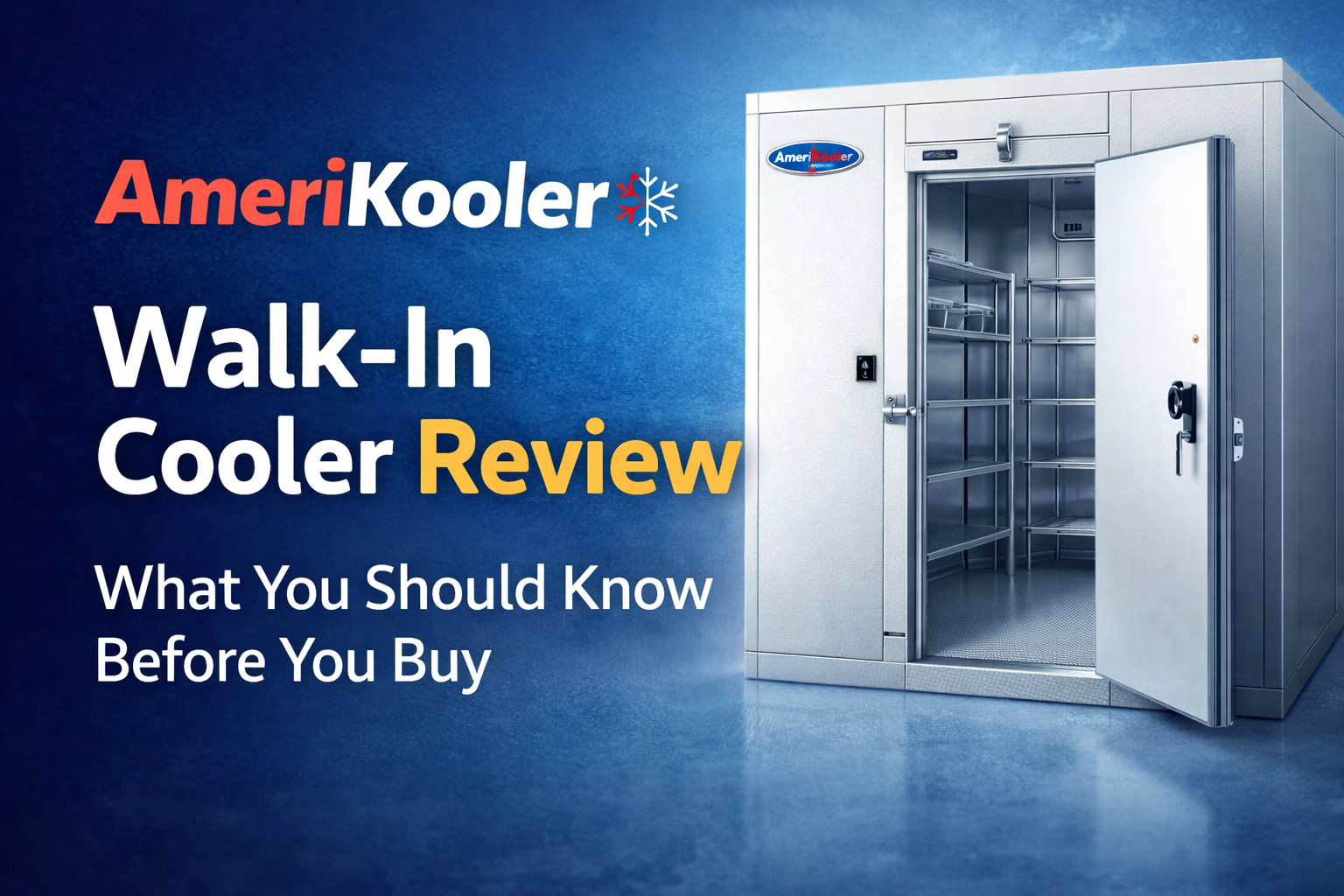
AmeriKooler Walk-In Cooler Review
A walk-in cooler usually becomes urgent right before it becomes expensive. A restaurant is opening in a few weeks. A grocery store needs more cold storage before the next busy season. A deli has outgrown reach-ins. A failing box is starting to threaten inventory. In moments like that, buyers do not want broad promises. They want a brand they can size up quickly: panel quality, insulation, floor strength, lead time, installation logic, and long-term durability.
That is why AmeriKooler gets real attention in the walk-in market. It is not a brand people stumble onto by accident and forget five minutes later. It tends to come up when buyers are already comparing serious options and trying to decide whether they should pay attention to the box itself, not just the refrigeration package. AmeriKooler’s core pitch is simple: modular walk-ins built around 4-inch XPS insulation, quick-ship availability on selected models, and a warranty package that puts unusual emphasis on long-term thermal performance. The company’s own materials highlight AK Series 3 Quick Ship models, 3-day lead times on qualifying indoor units, 4-inch AK-XPS4 insulation, and a 50-year thermal warranty on insulation.
That combination is exactly what makes the brand worth reviewing carefully. In walk-in refrigeration, many boxes can look similar from the outside. The real differences often sit inside the panel construction, in the floor details, in the way the door hardware holds up, and in how the enclosure performs after years of traffic, moisture, and repeated openings. AmeriKooler positions itself as a manufacturer that wants buyers to look beyond the quote price and examine those deeper details. Whether that translates into the right purchase for your business depends on what kind of operation you run and what kind of box you actually need.
Why AmeriKooler gets shortlisted so often
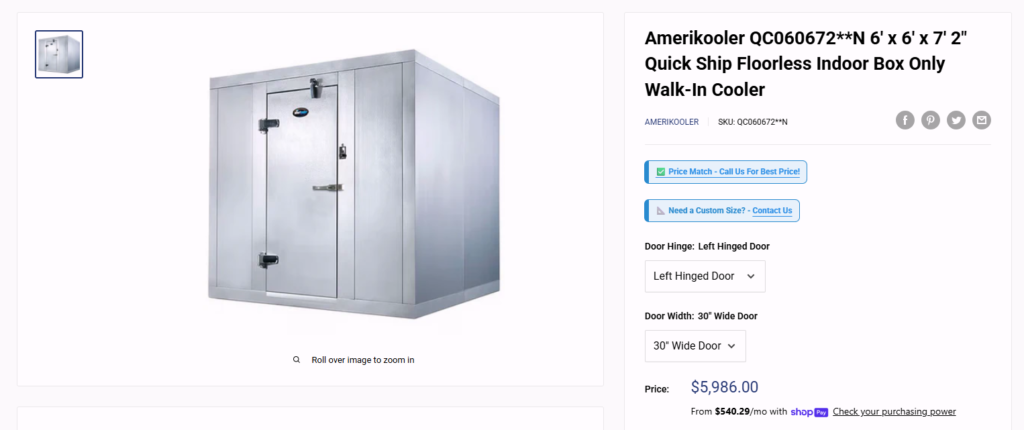
AmeriKooler is strongest when the buyer cares about three things at the same time: speed, insulation, and modular flexibility. The company’s Quick Ship line is one reason it stays visible in the market. On its Quick Ship page and flyer, AmeriKooler says AK Series 3 indoor quick-ship coolers and freezers are available in pre-specified sizes with a 3-day lead time, while outdoor quick-ship models have a longer lead time. For businesses trying to stay on schedule, that alone can move the brand into the conversation very quickly.
The second reason is the panel story. AmeriKooler leans heavily on AK-XPS insulation and makes it a central part of its identity. The company states that its quick-ship walk-ins use 4-inch AK-XPS4 insulation and publishes R-29 values for coolers and R-32 for freezers. On its XPS information pages, it also stresses moisture resistance and long-term R-value retention, arguing that XPS is especially well suited to the environment inside walk in coolers and freezers.
The third reason is configurability. AmeriKooler’s architectural specifications describe a modular system designed for fast field assembly, disassembly, and enlargement by adding panels. That matters more than many buyers realize. A walk-in is not always a forever box in a forever space. Restaurants expand, layouts change, and storage needs evolve. A manufacturer that thinks in modular terms is often easier to work with over the long run than one that treats the unit like a static product.
The real selling point: insulation that the brand actually talks about
Most buyers begin by looking at dimensions and door type. Better buyers start with the panel. That is where AmeriKooler has one of its clearest advantages.
The company repeatedly emphasizes that its walk-ins use 4-inch AK-XPS insulation and backs that with a 50-year thermal warranty on the insulation. It also states that the insulation supports R-29 performance for coolers and R-32 for freezers, which aligns with its published certifications and EISA-related performance claims.
Why does this matter in practical terms? Because the box is what determines how hard the refrigeration system has to work. A poor enclosure forces the system to fight harder against heat gain. That usually shows up later as more compressor strain, less efficient operation, and more frustration in hot kitchens or busy prep environments. A stronger panel system gives the refrigeration package a fairer workload. In daily operation, that can mean more stable temperatures, better efficiency, and fewer unpleasant surprises.
AmeriKooler’s XPS positioning is also relevant because moisture is one of the quiet enemies of insulation performance. The company specifically argues that its AK-XPS Grey insulation has hydrophobic properties intended to reduce water absorption in low-temperature applications. Whether a buyer agrees with every bit of the brand’s sales language, the important takeaway is that AmeriKooler is not trying to win only on surface features. It is trying to win by making insulation part of the buying decision. In the walk-in category, that is a serious argument, not a decorative one.
Quick Ship: where AmeriKooler becomes especially attractive
One of the biggest reasons businesses look at this brand is speed. AmeriKooler says its AK Series 3 indoor quick-ship units are built around nine standard sizes and four heights, with a 3-day lead time on qualifying models. That is not a small operational detail. It changes the kind of buyer who can realistically consider the brand.
A buyer planning a brand-new build months in advance has time to compare every detail and possibly go fully custom. A buyer who has a delayed construction schedule, an equipment failure, or a business opening deadline often does not. Quick-ship availability makes AmeriKooler especially relevant for restaurants, small markets, florists, beverage programs, and foodservice operations that need something dependable without getting trapped in a long production cycle.
That said, quick-ship is not the same as unlimited flexibility. AmeriKooler is clear that these are pre-specified sizes and configurations. That is the tradeoff. You gain speed, but you work within a narrower menu. For many buyers, that is an easy compromise. For others, especially those with odd site conditions or unusual floor-loading needs, custom may still be the smarter path.
Warranty: one of the brand’s strongest arguments
If there is one part of the AmeriKooler story that gives buyers confidence quickly, it is the warranty structure. The Quick Ship flyer lists a 50-year thermal warranty on insulation, a 15-year panel warranty, a 5-year door and floor warranty, and 1-year labor and parts coverage. That is a meaningful breakdown because it shows exactly where the manufacturer is expressing the most confidence: insulation and panel integrity first, doors and floors next, then shorter-term coverage on labor and parts.
That does not mean buyers should stop reading after the headline numbers. Final quote terms and written warranty language still matter. But compared with many generic equipment listings that barely explain anything, AmeriKooler gives buyers a much clearer sense of how the product is supported. In a category where the enclosure quality matters as much as the refrigeration package, a long-term panel and thermal warranty is not just good optics. It is one of the most persuasive signals a manufacturer can send.
For many businesses, this is where AmeriKooler starts to make financial sense even when it is not the absolute lowest quote. A cheaper box that ages poorly or forces the refrigeration side to work harder can become expensive in a less visible way. Strong warranty language does not eliminate all risk, but it often points to a manufacturer that understands what buyers worry about after installation, not just before the sale.
Floor construction matters more than most buyers expect
One of the most useful things about AmeriKooler is that it publishes practical floor information instead of treating floors like an afterthought. In its product materials and floor selection resources, the company lists floor options and load capacities, including smooth aluminum or stainless floors rated for 700 pounds per square foot of uniformly distributed load, heavier-duty options for rolling cart traffic, and even an “Ultimate” floor designed for hand pallet jack applications in its architectural documentation.
That matters because many walk-in problems start at the floor. In a real restaurant, boxes are not used gently. Staff drag product in and out, carts hit thresholds, pallets show up unexpectedly, and heavy loads end up parked in one place longer than anyone intended. AmeriKooler’s own floor guide says floors are often the first part of the walk-in to feel the wear and tear of a busy kitchen. That is exactly right.
This is one of the areas where AmeriKooler feels like a brand built for real commercial use rather than just catalog presentation. It gives buyers enough information to ask better questions: Do I need a floorless box? Will I be using carts? Is hand pallet jack traffic realistic? Is a standard floor enough, or do I need reinforcement? Those are the questions that help prevent bad purchases.
Installation and build logic: a strong point for the brand
AmeriKooler also scores well on installation transparency. The company provides installation manuals, resources, FAQs, and architectural specifications that describe field assembly, panel dimensions, and component weights. According to its construction FAQ, wall and ceiling panels weigh 2.4 pounds per square foot, floors weigh 3.9 pounds per square foot, and a standard door weighs 165 pounds.
Those numbers are more useful than they may look at first. Buyers and contractors can use them to think through unloading, moving panels into position, labor needs, and site readiness before the crate arrives. That reduces friction at exactly the stage where friction tends to become expensive.
The architectural specifications also note that the walk-ins are intended for rapid field assembly and disassembly and can be enlarged by adding panels. That modular thinking is valuable for buyers who want future flexibility, particularly in foodservice and retail settings where storage needs can change faster than expected.
Compliance and approvals: reassuring for serious buyers
Another reason AmeriKooler feels credible is that it publishes its compliance story clearly. The certifications page states compliance with NSF Standard 7, EISA-related requirements, and UL-listed panels and doors. Its architectural specs also reference several regional approvals, including Miami-Dade and State of Florida high-velocity wind approvals for qualifying outdoor hurricane applications.
For many buyers, especially those dealing with outdoor placement, code-sensitive installations, or contractor-driven projects, this matters a lot. It is one thing for a manufacturer to say its products are built well. It is another thing to provide documented standards and approvals that a project team can actually use. AmeriKooler does the latter better than many brands in the category.
Where AmeriKooler is a strong fit
AmeriKooler makes the most sense for buyers who care about the enclosure as much as the refrigeration package. Restaurants with serious back-of-house traffic, grocery and deli operations, flower and beverage applications, and businesses comparing quick-ship versus custom modular boxes are all reasonable candidates.
It is especially attractive when one or more of these conditions apply: you need dependable quick-ship timing, you care about long-term panel and insulation performance, you want stronger documentation before ordering, or you expect the walk-in to operate in a demanding commercial setting where floor performance and door durability matter.
The brand is also a good fit for buyers who are tired of vague product pages. AmeriKooler provides enough published detail to let you think like an operator instead of a casual shopper.
Where buyers should pause and ask harder questions
No walk-in brand is perfect for every project. AmeriKooler is strong, but buyers should still slow down and think carefully in a few areas.
First, quick-ship convenience can tempt buyers into forcing a standard size into a space that really needs a better custom layout. That is not the brand’s fault, but it happens. Second, if your project involves unusual traffic patterns, outdoor exposure, or heavier loads than usual, floor and configuration choices become more important than the base model itself. Third, the box and the refrigeration package should be evaluated together. A strong enclosure is a major advantage, but the final system still has to be sized and specified correctly for the application.
In other words, AmeriKooler is not the kind of brand you buy purely by headline. It rewards buyers who look closely.

Related Posts
Buying a Walk-In Cooler in New Jersey
Buy Used Walk In Cooler