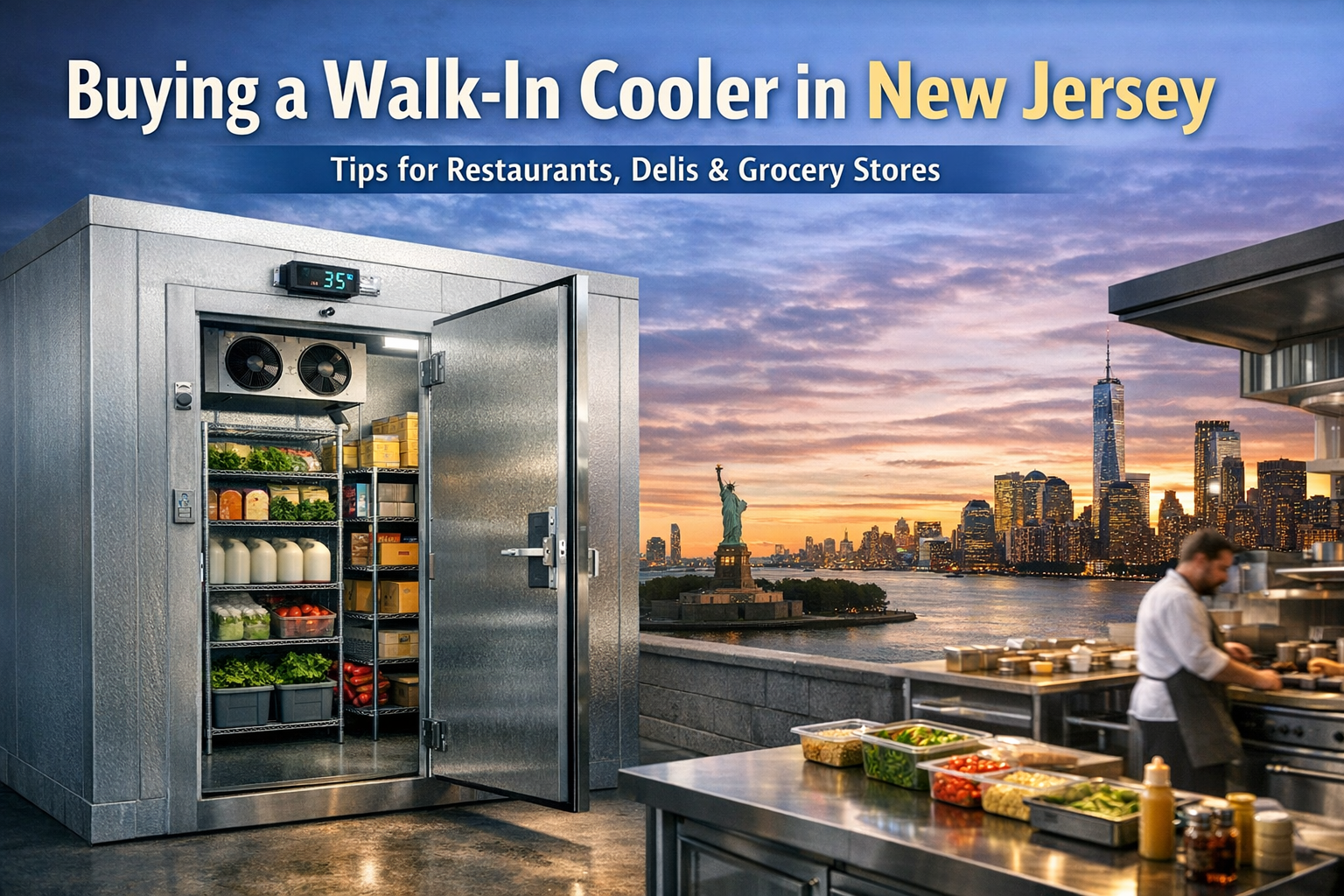
Buying a Walk-In Cooler in New Jersey
Buying a walk-in cooler in New Jersey is not just a matter of choosing dimensions and requesting a quote. For most businesses, it is a decision that directly affects food safety, kitchen workflow, compliance readiness, energy costs, and the long-term reliability of the operation. Whether you are opening a new restaurant, replacing an aging box in an existing deli, expanding a grocery back room, or building out storage for a commissary kitchen, the right walk-in cooler should be selected with far more care than many first-time buyers expect.
In New Jersey, that is especially true. Businesses often operate in older buildings, tight commercial spaces, mixed-use properties, and high-cost markets where inefficient decisions become expensive quickly. A walk-in cooler is not simply cold storage. It is part of your daily production system, your inventory protection strategy, and your ability to maintain consistent temperatures during busy service periods. New Jersey food regulations are built around the expectation that refrigeration keeps potentially hazardous food at 41°F or below, and FDA cooling guidance reinforces how critical this temperature threshold is for food safety.
That is why buyers in this market need more than a generic equipment overview. They need a practical guide that connects the technical side of the purchase with the real conditions of operating in New Jersey.
Why New Jersey Buyers Need a More Careful Walk-In Cooler Strategy
Many articles about walk-in coolers focus only on box size, panel thickness, or compressor type. Those details matter, but in New Jersey they are only part of the decision. A buyer here also has to think about building conditions, inspection expectations, utility costs, service accessibility, and the type of business the cooler is supporting.
A pizzeria in Newark, a deli in Jersey City, a florist in Bergen County, and a grocery store in Paterson may all need walk-in refrigeration, but the ideal setup for each one can be very different. Door swing, traffic frequency, product mix, site access, and daily loading patterns all influence what kind of walk-in cooler makes sense. If those variables are ignored, the business may end up with a unit that technically works but performs poorly in real life.
For businesses comparing options at the product level, reviewing a wider inventory of walk-in coolers is often the best starting point. It gives buyers a broader understanding of common sizes, configurations, and box styles before they narrow the decision to a local project in New Jersey.
Start With the Real Use Case, Not Just the Available Space
One of the most common buying mistakes is choosing a walk-in cooler based only on the floor area available. This seems logical at first, but it often leads to poor long-term results. The better approach is to begin with the operation itself.
What will the cooler store on a daily basis? Will it mainly hold produce, dairy, beverages, meat, prepared foods, flowers, or bulk ingredients? How often will staff enter the cooler during peak hours? Will inventory rotate quickly, or is the cooler primarily being used for overnight storage? Are you trying to support prep, receiving, and active service from the same box?
These questions matter because a walk-in cooler must do more than fit physically. It must support airflow, shelf organization, employee movement, and temperature recovery. A box that is too small may cause crowding and inconsistent loading patterns. A box that is too large may consume valuable square footage and increase operating cost unnecessarily. The right size is the one that fits both the room and the workflow.
This is where experienced buyers usually outperform first-time buyers. They do not just ask, “Will it fit?” They ask, “Will it work efficiently every day?”
Food Safety Is Not a Side Issue in New Jersey
If your business handles food, the walk-in cooler is directly tied to compliance and risk management. New Jersey’s retail food sanitation rules require cold-holding temperatures that align with the 41°F benchmark, and FDA guidance on cooling cooked food emphasizes that food should move from 135°F to 70°F within two hours, then from 70°F to 41°F or below within the next four hours.
This does not mean a walk-in cooler should be treated like a blast chiller, but it does mean buyers need to think realistically about how the cooler will support safe storage and disciplined kitchen processes. If the unit is overloaded, poorly organized, slow to recover, or constantly exposed to warm air from heavy traffic, maintaining consistent temperatures becomes harder. That affects not only food quality, but operational confidence.
For New Jersey restaurants, delis, and markets, the right walk-in cooler is part of a broader food safety system. It should help staff maintain stable storage conditions, not create extra temperature-management problems.
Installation Planning Matters More Than Most Buyers Expect
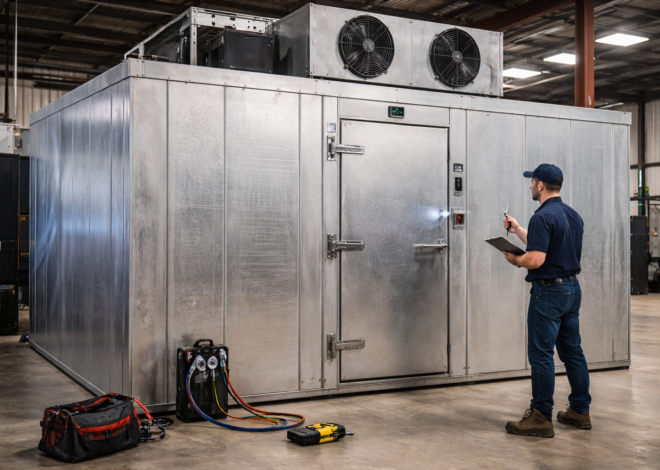
A walk-in cooler project is rarely just a box purchase. In many New Jersey buildings, installation is where the complexity begins.
You may be dealing with low ceilings, narrow access points, older electrical systems, uneven floors, remote condenser placement, or limited back-of-house working room. In some projects, the site can physically accept the cooler but still create major service, drainage, or ventilation problems later. That is why serious buyers evaluate the full project conditions before finalizing equipment.
New Jersey’s construction rules make this even more relevant. State code materials explain that work involving building, plumbing, electrical, or mechanical scope can require permits, and repair work by itself is not automatically treated the same way as more substantial installation or alteration work.
For a walk-in cooler buyer, the practical takeaway is simple: do not assume the installation is “basic” just because the equipment itself seems straightforward. If the project involves electrical work, refrigeration lines, drainage, remote condensing units, structural changes, or modifications to an existing commercial space, local review may become part of the process. In a market like New Jersey, that is not an unusual complication. It is part of buying professionally.
Choosing Between Self-Contained and Remote Refrigeration
This is one of the most important decisions in the buying process, and it is often misunderstood.
A self-contained system can be attractive because it feels simpler. The refrigeration package is integrated, the buying process can be more straightforward, and in some applications it absolutely makes sense. But simplicity on paper does not always translate to the best operating environment.
In a hot kitchen, a self-contained unit may add unwanted heat to the workspace. In a tight back room, service access may become awkward. In a noise-sensitive environment, a remote system may provide a cleaner long-term solution. On the other hand, some smaller operations prefer the relative convenience and straightforwardness of a self-contained configuration.
The right answer depends on the building, the traffic level, the surrounding temperatures, the maintenance plan, and the way the staff actually uses the space. Buyers who only compare upfront pricing often miss this. Buyers who think in terms of total operational fit usually make better decisions.
Energy Efficiency Is a Buying Issue, Not Just a Utility Issue
A walk-in cooler is not a one-time expense. It is a long-term operating asset. That means the buying decision should include energy performance from day one.
Federal energy standards for walk-in coolers and freezers continue to evolve, and the U.S. Department of Energy has published updated compliance timelines for non-display doors and refrigeration systems in this category. DOE also treats walk-ins by their major components, such as doors, panels, and refrigeration systems, which reinforces the idea that performance is shaped by the full assembly, not just the condensing unit.
For New Jersey businesses, this matters even more because energy costs and overhead pressure can make inefficient refrigeration painfully expensive over time. Good panel integrity, high-quality door gaskets, dependable closers, proper installation, and smart accessories all contribute to better efficiency. A cheaper box that leaks air or struggles with door sealing may cost less to buy, but more to own.
When evaluating quotes, buyers should think beyond the purchase number and ask a more strategic question: how much will this unit cost to operate over the next five to ten years?
What Smart Buyers Compare Before Making a Final Decision
A professional buying process is never just about price. Two walk-in cooler quotes can look similar at a glance and still represent very different levels of long-term value.
Smart buyers compare panel construction, insulation quality, floor options, door style, refrigeration design, service access, warranty structure, and installation assumptions. They also look at how well the supplier understands the actual project. Is the conversation only about dimensions and payment? Or is the supplier asking useful questions about the site, inventory type, traffic pattern, and installation constraints?
That difference matters. A supplier who understands the real-world demands of a New Jersey installation is often far more valuable than one who simply offers a lower number without real project guidance.
For buyers who want a location-specific path forward, Walk-In Cooler NJ is a relevant resource to review when the decision has moved beyond general comparison and into the practical realities of buying for a New Jersey operation.
Common Mistakes to Avoid When Buying a Walk-In Cooler in NJ
The first mistake is buying based only on footprint. The second is buying based only on price. The third is underestimating installation complexity.
Another common mistake is failing to plan for future growth. A cooler that feels adequate today may become restrictive in a year if product volume increases or workflow changes. Some businesses also ignore serviceability, only to discover later that a poorly placed condensing unit or cramped installation makes every maintenance issue harder and more expensive.
Finally, many buyers fail to connect the walk-in cooler to the rest of the operation. Refrigeration should support receiving, prep, storage, and retrieval in a logical way. If the box disrupts workflow instead of improving it, the business pays for that mistake every day.
Final Thoughts: Buy for Performance, Not Just for Delivery Day
The best walk-in cooler for a New Jersey business is not necessarily the cheapest, the biggest, or the one with the fastest quote turnaround. It is the one that best matches the business’s inventory, daily rhythm, building conditions, and long-term cost priorities.
That is what professional buyers understand. They know that a walk-in cooler should not be judged only by how it looks on a quote sheet. It should be judged by how it performs in the real environment where the business actually operates.
If you are buying a walk-in cooler in New Jersey, take the time to evaluate the full picture: food safety expectations, installation realities, traffic patterns, refrigeration style, energy performance, and growth needs. When those factors are aligned, the cooler stops being just another equipment purchase and becomes a reliable part of your operation.

Related Posts
Mr. Winter Walk-In Coolers and Freezers Review
AmeriKooler Walk-In Cooler Review