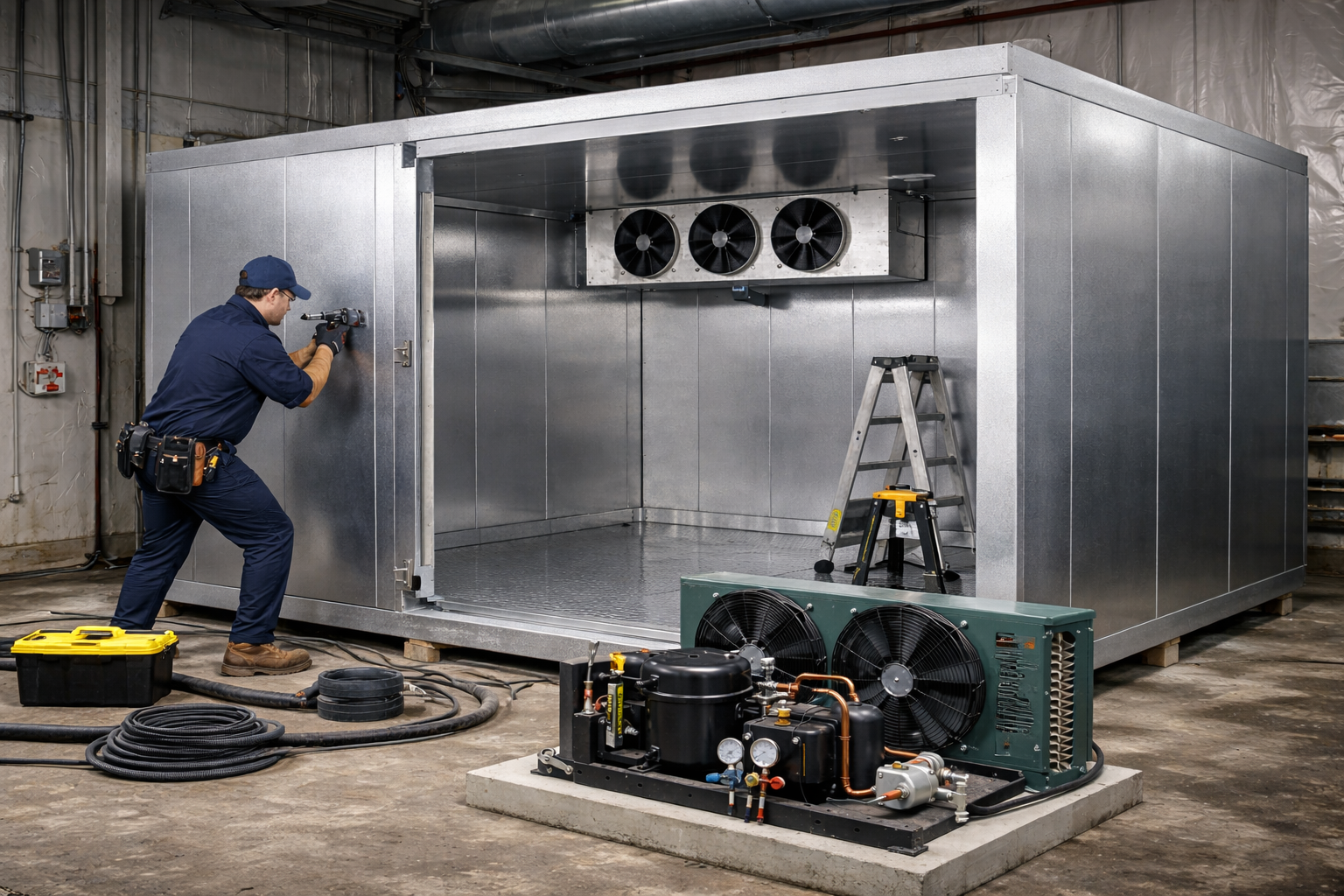
Commercial Walk in Freezer Installation
Installing a commercial walk-in freezer is not a simple equipment purchase. It is a mechanical, structural, and operational system installation where a single oversight can lead to temperature instability, excessive energy consumption, compressor failure, or even health department violations. Unlike reach-in freezers, walk-in freezers operate at low temperatures for extended cycles, making correct installation absolutely critical.
This guide breaks down the installation process exactly the way experienced refrigeration contractors approach it in the field—from site assessment to long-term reliability considerations. If you are planning a new freezer installation or evaluating an existing one, this article will give you a realistic, professional perspective on what truly matters.
Commercial Walk in Freezer Installation Planning
Every successful walk-in freezer installation starts long before panels arrive on site. A proper site assessment determines whether the freezer will operate efficiently for years or become a constant source of service calls.
The first step is verifying usable footprint and clearances, not just overall room size. Walk-in freezers require space for door swing, interior airflow, evaporator clearance, and in many cases service access above the unit. Installers routinely encounter issues where ceiling height is technically sufficient, but insufficient for evaporator mounting or air circulation.
Next comes floor and load evaluation. A fully stocked commercial freezer can weigh several thousand pounds once product, shelving, and personnel traffic are factored in. Concrete slab integrity, insulation below grade, and vapor barrier continuity must be confirmed. For installations above ground level or in older buildings, structural load calculations are often required.
Electrical planning is another critical area. Walk-in freezers almost always require a dedicated electrical circuit, specific voltage and phase configuration, and sufficient amperage headroom. Failure to confirm this upfront often results in costly last-minute electrical upgrades or unsafe temporary solutions.
Finally, local building codes and health department regulations must be reviewed. Many jurisdictions have strict requirements regarding door safety releases, lighting, temperature monitoring, and floor sanitation. Addressing these items during planning avoids delays, failed inspections, and operational downtime.
Insulation Panels, Flooring & Structural Assembly
The structural shell of a walk-in freezer is where thermal efficiency is either locked in or permanently compromised. Unlike walk in coolers, freezers must resist extreme temperature differentials, making insulation performance critical.
Commercial freezer panels are typically constructed with high-density foam cores designed to deliver elevated R-values. The quality of these panels, and how they are joined, determines the freezer’s resistance to heat infiltration and moisture migration. Cam-lock systems are standard in professional installations, but correct alignment and compression during assembly are essential to prevent air leaks.
Moisture control is a major concern. Improper sealing allows warm, humid air to infiltrate the freezer, leading to frost buildup, ice expansion, and eventual panel separation. This is why experienced installers treat vapor barriers and joint sealing as precision work rather than basic assembly.
Flooring decisions are equally important. Some freezers are installed directly on insulated floors, while others are built as floorless systems on prepared slabs. Each approach has implications for sanitation, load distribution, and long-term thermal performance. In freezer applications, insufficient floor insulation almost always results in frost heave, ice formation, or uneven temperature zones.
Structural integrity is not just about keeping panels upright—it is about maintaining thermal continuity throughout the entire enclosure.
Refrigeration System Selection & Configuration
The refrigeration system is the heart of the walk-in freezer, and incorrect selection is one of the most expensive mistakes in commercial refrigeration.
Freezers operate in low-temperature ranges that demand precise capacity calculations, not rough estimates. Load calculations must consider internal volume, product type, door usage frequency, ambient temperature, and future growth. Undersized systems struggle to recover temperature, while oversized systems short-cycle and suffer premature compressor wear.
System configuration is another major decision. Remote refrigeration systems place the condenser outside the building, reducing heat and noise indoors but increasing installation complexity. Self-contained systems are easier to install but introduce additional heat load into the space. The right choice depends on the facility layout, ventilation, and long-term operational priorities.
Evaporator placement inside the freezer affects airflow uniformity. Poor placement creates hot spots, frost accumulation, and uneven product freezing. Professionals ensure proper air throw patterns and avoid dead zones, particularly in high-density storage applications.
Defrost strategy is often overlooked but essential. Electric defrost, hot gas defrost, and off-cycle defrost each have specific use cases. Choosing the wrong defrost method can increase energy consumption or cause ice buildup that damages evaporator coils over time.
Electrical, Drainage & Ventilation Requirements
A walk-in freezer is as much an electrical system as it is a refrigeration system. Improper electrical installation is one of the leading causes of compressor failure and safety hazards.
All freezer systems require dedicated electrical circuits with proper overcurrent protection. Voltage drops, shared circuits, or incorrect phase connections lead to unstable operation and repeated service issues. Professional installations always verify voltage under load, not just at startup.
Condensate drainage is another critical component. Freezers produce water during defrost cycles, and that water must be safely removed without freezing. Drain lines often require heat tracing or insulation to prevent ice blockages, especially in colder environments.
Ventilation planning applies primarily to condenser units. Whether mounted outdoors or in mechanical rooms, condensers must be able to reject heat efficiently. Restricted airflow leads to elevated head pressure, reduced efficiency, and shortened equipment life.
Noise, vibration, and heat discharge must also be managed carefully, particularly in retail or hospitality environments where customer comfort is a concern.
Commissioning, Testing & Temperature Calibration
Commissioning is where professional installations clearly separate themselves from rushed or inexperienced work. Turning on the freezer is not the same as verifying correct operation.
After startup, the system must be allowed to pull down temperature gradually, stabilizing internal conditions without overloading the compressor. Temperature sensors, thermostats, and alarms must be calibrated to ensure accurate readings and compliance with food safety standards.
Door seals, heaters, and pressure relief ports are tested to confirm airtight integrity. Even minor leaks can cause significant ice formation over time. Lighting, safety releases, and monitoring systems are also verified at this stage.
The first 48 to 72 hours of operation are critical. Experienced technicians monitor cycling behavior, defrost performance, and temperature recovery to confirm the system is operating within design parameters.
Skipping or rushing commissioning often results in long-term performance issues that could have been prevented with proper testing.
Common Installation Mistakes & Long-Term Maintenance Considerations
Many walk-in freezer problems are not caused by faulty equipment, but by avoidable installation errors. Misaligned panels, insufficient insulation, poor airflow design, and improper electrical connections account for a significant percentage of service calls.
Another frequent issue is neglecting long-term maintenance access. Freezers installed too close to walls or ceilings often become difficult to service, increasing labor costs and downtime.
Preventive maintenance is essential for freezer longevity. Regular inspection of door gaskets, evaporator coils, defrost heaters, and drain lines helps prevent small issues from escalating into system failures. Cleaning condensers and verifying refrigerant charge on a scheduled basis significantly improves efficiency and equipment lifespan.
A properly installed walk-in freezer should operate reliably for many years. When installation shortcuts are taken, the cost is paid repeatedly through repairs, energy waste, and product loss.
