How Much Is a Walk In Cooler?
If you ask ten restaurant owners how much a walk-in cooler costs, you will likely get ten very different answers. Some will quote a number they heard years ago. Others will mention a price that excludes installation, refrigeration, or electrical work. The truth is that walk-in cooler pricing depends heavily on size, configuration, refrigeration system, installation conditions, and how the cooler will be used in daily operations.
This article is written from an industry-insider perspective, not a catalog summary. The goal is to give you a realistic, decision-ready understanding of walk-in cooler costs, starting with one of the most aggressively priced and popular entry-level options on the market today.
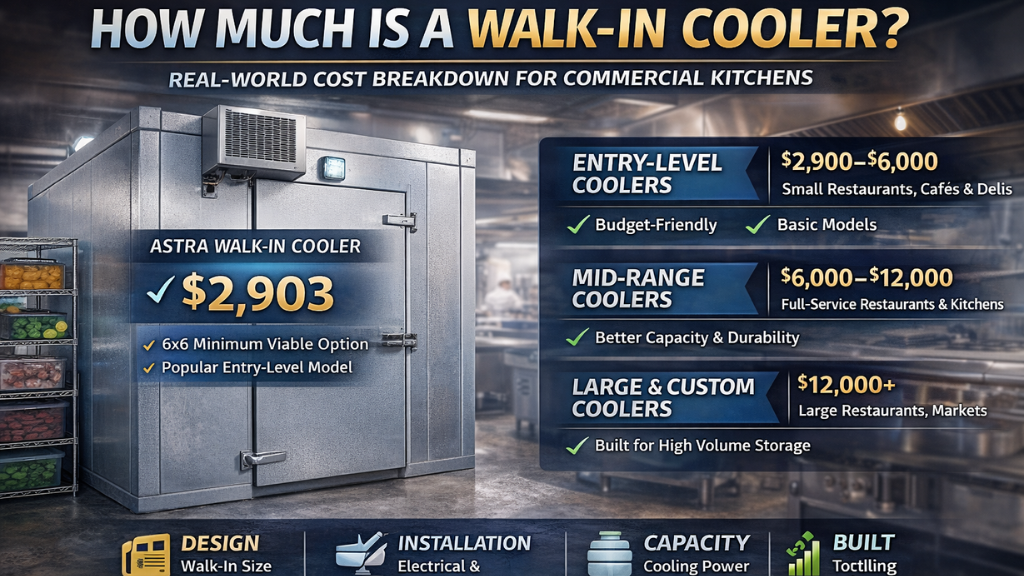
Astra Walk In Cooler – $2,903
At the very bottom of the walk-in cooler price spectrum sits the Astra Walk-In Cooler, with a starting price of $2,903. This price point is important because it reshapes expectations around what a “minimum viable” commercial walk-in cooler can cost.
At this level, you are typically looking at a small, indoor, self-contained walk-in cooler kit, designed for restaurants, cafés, delis, food trucks with fixed commissaries, and small commercial kitchens that need reliable cold storage without complex customization.
The $2,903 price generally covers insulated panels, cam-lock construction, a basic door assembly, and compatibility with a standard refrigeration system. It does not mean the cooler is incomplete or unsafe. It means the design is intentionally simplified to reduce manufacturing and logistics costs.
For many first-time restaurant owners or expanding kitchens, this price point is often the difference between installing a walk-in cooler now versus trying to survive with reach-ins that are constantly overloaded.
However, this is only the starting line. To understand whether $2,903 is “cheap” or “expensive,” you need to understand how walk-in cooler pricing scales as requirements increase.
What Actually Determines the Price of a Walk-In Cooler?
Before comparing models and price tiers, it is critical to understand what you are actually paying for when you buy a walk-in cooler. The final cost is not just about square footage.
Panel thickness and insulation quality play a major role. Most commercial walk-in coolers use polyurethane foam insulation, but thickness varies. Thicker panels improve energy efficiency and temperature stability but increase cost.
Refrigeration system choice is another major factor. Self-contained systems are cheaper and easier to install, while remote condenser systems cost more upfront but reduce heat and noise inside the kitchen.
Door configuration matters more than most buyers expect. A standard hinged door is inexpensive. A heavy-duty traffic door, glass door, or dual-door setup can add hundreds or thousands of dollars.
Installation conditions also impact cost. A walk-in cooler installed on a flat slab with clear access is far cheaper than one installed in a tight basement, rooftop, or older building with electrical and ventilation constraints.
Finally, compliance and performance expectations matter. Units designed for high-volume kitchens with frequent door openings require stronger refrigeration capacity, better airflow management, and more durable hardware.
Entry-Level Walk-In Coolers: $2,900–$6,000
This category is where the Astra walk-in cooler sits. Entry-level walk-ins are typically compact, indoor units designed for light to moderate use.
In this range, you are usually looking at sizes between 6×6 and 6×8 feet, standard panel heights, basic doors, and simple refrigeration compatibility. These coolers are ideal for small restaurants, coffee shops, bakeries, pizza shops, and prep kitchens that need reliable cold storage but are not running continuous high-volume service.
The advantage of this price range is accessibility. These coolers can often be installed quickly, sometimes within a single day, and they usually work with standard electrical setups. Maintenance is straightforward, and replacement parts are easy to source.
The limitation is capacity and resilience. If your operation involves frequent door openings, large batch storage, or heavy daily turnover, an entry-level walk-in may struggle over time.
Mid-Range Walk-In Coolers: $6,000–$12,000
This is the most common price range for full-service restaurants and growing commercial kitchens. In this tier, you start to see larger footprints, thicker panels, higher-capacity refrigeration systems, and better airflow design.
Mid-range walk-in coolers often support more complex layouts. They may include floor panels, reinforced doors, upgraded hinges, and improved sealing. Refrigeration systems in this range are designed to recover temperature faster after door openings, which is critical during busy service hours.
From an operational standpoint, this range offers the best balance between cost and performance. Energy efficiency improves, temperature consistency stabilizes, and long-term durability increases.
For many operators, spending more upfront in this range results in fewer service calls, lower energy bills, and less food waste over the life of the cooler.
Large and Custom Walk-In Coolers: $12,000–$25,000+
Once you move into large restaurants, supermarkets, commissary kitchens, or institutional foodservice, walk-in cooler pricing escalates quickly.
In this tier, coolers are often custom-built to fit specific spaces. Panel heights may be taller, doors may include strip curtains or traffic-rated designs, and refrigeration systems are often remote-mounted on rooftops or exterior pads.
Installation becomes a significant part of the cost. Electrical work, refrigerant line runs, roof penetrations, and building permits all add to the final price.
These coolers are built for constant use. They are designed to maintain temperature under heavy load, frequent access, and large product volumes. The upfront cost is higher, but the performance and reliability justify the investment for high-volume operations.
Installation Costs: The Hidden Variable
One of the most common mistakes buyers make is focusing solely on the price of the walk-in cooler itself and ignoring installation.
Basic installations for small indoor units may cost only a few hundred dollars. More complex installations can easily exceed the cost of the cooler.
Electrical upgrades, ventilation requirements, and local code compliance all factor into installation pricing. In older buildings, these costs can be unpredictable.
This is why a $2,903 walk-in cooler can realistically become a $4,000–$5,000 project once installed, while a $10,000 cooler can turn into a $15,000 total investment in challenging environments.
Operating Costs Over Time
The purchase price is only part of the financial picture. Walk-in coolers run 24/7, and their operating cost adds up over years of use.
Better insulation reduces compressor run time. Higher-quality door seals prevent temperature loss. Proper sizing prevents short cycling and premature compressor failure.
An entry-level cooler may cost less upfront but more over time if it struggles to maintain temperature under real-world conditions. A properly sized mid-range unit often delivers a better total cost of ownership.
Choosing the Right Price Point for Your Kitchen
The correct walk-in cooler is not the cheapest one available. It is the one that matches your actual usage patterns.
If you are opening a small restaurant with limited prep and predictable storage needs, starting with a $2,903 Astra walk-in cooler can be a smart, low-risk decision.
If you are operating a high-volume kitchen with constant access and large batch storage, investing more upfront will almost always save money in the long run.
The key is honesty about how your kitchen really operates, not how you hope it will operate.

Related Posts
Buy Used Walk In Cooler
Walk-In Cooler Repair