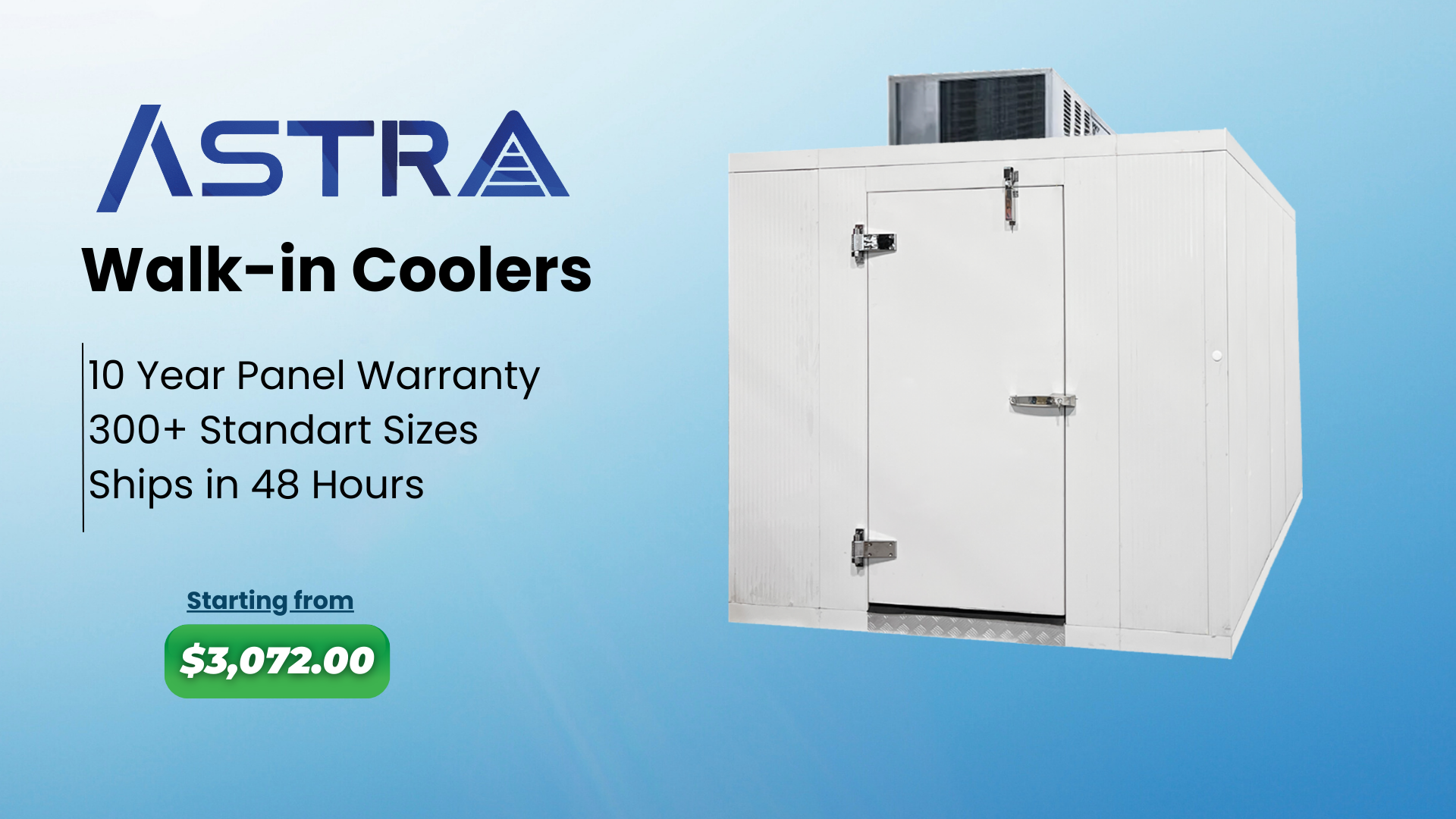
Walk-In Cooler Costs Explained
Walk-in coolers are not impulse purchases. They are long-term infrastructure investments that quietly determine food safety, operational efficiency, energy costs, and business continuity.
Yet when buyers search for “walk-in cooler costs,” most articles give vague ranges, incomplete explanations, or misleading low numbers that ignore real-world conditions. That leads to one of two outcomes: buyers either overspend unnecessarily—or worse, underinvest and pay for it repeatedly through repairs, energy waste, and downtime.
This guide exists to prevent both. By the end of this article, you will not only understand exactly what walk-in coolers cost, but why high-quality systems, especially Astra Walk-In Coolers, deliver the best total value over time.
The Real Cost Range of Walk-In Coolers
Most buyers expect a simple answer to walk-in cooler pricing. The reality is more nuanced.
A basic walk-in cooler can start around $5,000, while fully customized, large-scale systems can exceed $30,000. That wide range exists because walk-in coolers are not standardized products—they are modular systems designed around your space, usage, and compliance requirements.
The biggest pricing variables include:
- Physical size and interior volume
- Insulation thickness and panel quality
- Refrigeration system type and efficiency
- Indoor vs outdoor installation
- Electrical and climate conditions
- Installation complexity
- Long-term operating costs
The mistake most buyers make is focusing only on upfront cost. In practice, the purchase price is often the smallest cost component over the unit’s lifespan.
Walk-In Cooler Size and Configuration
Size is the most visible cost factor—but also one of the most misunderstood.
A small walk-in cooler designed for a café or deli may require only 80–120 square feet. Large restaurants, supermarkets, and commissary kitchens often need several hundred square feet or more. As size increases, costs scale not only in materials but in refrigeration capacity, energy consumption, and structural requirements.
However, bigger is not always better.
Over-sizing leads to wasted space, higher energy bills, and unnecessary capital expenditure. Under-sizing leads to airflow issues, inconsistent temperatures, and inventory loss.
Astra Walk-In Coolers are designed with precision sizing philosophy—balancing capacity with airflow efficiency so businesses pay for what they actually need, not what sounds impressive on paper.
Insulation and Panel Quality
One of the most common pricing traps in the walk-in cooler market is insulation.
Low-cost systems often reduce price by using thinner panels or inferior foam insulation. This saves money upfront—but causes higher energy consumption every single day the unit operates.
High-quality walk-in coolers use thicker panels with high-density insulation that:
- Maintain consistent internal temperatures
- Reduce compressor workload
- Improve food safety stability
- Lower long-term energy costs
Astra Walk-In Coolers prioritize insulation performance because energy efficiency compounds over time. A slightly higher upfront investment can save thousands of dollars over the unit’s lifespan.
This is where many “cheap” coolers quietly become the most expensive option.
Refrigeration Systems
The refrigeration system is the heart of a walk-in cooler—and one of the most important cost drivers.
Basic systems may appear cheaper, but they often lack:
- Efficient temperature recovery
- Stable performance under heavy use
- Modern refrigerants
- Advanced control systems
Higher-quality systems focus on:
- Energy-efficient compressors
- Consistent airflow distribution
- Environmentally friendly refrigerants
- Reliable digital temperature control
Astra Walk-In Coolers are engineered around commercial-grade refrigeration systems designed for continuous operation, not short-cycle residential performance. This results in better temperature stability, lower maintenance frequency, and predictable operating costs.
In real kitchens, reliability is not a luxury—it is a requirement.
Walk-In Cooler Costs for Installation
Many walk-in cooler cost guides fail to mention installation—or treat it as an afterthought. In reality, installation can significantly affect total cost.
Installation expenses depend on:
- Indoor vs outdoor placement
- Electrical requirements and voltage
- Floor preparation
- Ventilation and clearance
- Local code compliance
- Access constraints during delivery
Poor installation can sabotage even the best equipment. Astra works with installation standards that account for airflow, service access, and long-term performance—ensuring the system operates as designed, not merely as assembled.
A properly installed walk-in cooler protects your investment from day one.
Energy Costs Over Time
Walk-in coolers run continuously. That makes energy efficiency one of the largest lifetime cost factors.
A cooler that saves even a small amount of energy daily compounds those savings every month, every year. Over a typical service life, inefficient systems can cost thousands more in electricity than their purchase price difference.
Astra Walk-In Coolers are designed to:
- Minimize heat transfer
- Reduce compressor cycling
- Maintain stable temperatures with less energy
For businesses operating on tight margins, energy efficiency is not optional—it is strategic.
Maintenance, Downtime, and the Cost of Failure
Downtime is one of the most expensive hidden costs in commercial refrigeration.
When a walk-in cooler fails:
- Inventory is at risk
- Operations slow or stop
- Staff productivity drops
- Emergency service costs increase
Low-quality systems tend to fail at the worst possible time—during peak hours or busy seasons.
Astra Walk-In Coolers are built to minimize unplanned downtime through:
- Durable components
- Service-friendly design
- Stable operating systems
- Commercial-grade materials
Reliability reduces not only repair costs, but also stress, liability, and lost revenue.
Why Astra Walk-In Coolers Deliver the Best Long-Term Value
When buyers compare walk-in cooler prices alone, Astra may not always appear to be the cheapest option. But price and cost are not the same thing.
Astra Walk-In Coolers consistently outperform lower-priced competitors because they:
- Reduce energy consumption over time
- Require fewer repairs
- Maintain stable food-safe temperatures
- Deliver predictable performance
- Protect inventory and operations
Businesses that choose Astra are not paying more—they are paying smarter.
A walk-in cooler is not just cold storage. It is:
- Food safety insurance
- Operational stability
- Energy efficiency infrastructure
- Compliance protection
- Long-term cost control
When evaluated through that lens, Astra Walk-In Coolers stand out as a strategic investment—not a line item expense.
If your business depends on reliable refrigeration—and most do—then choosing a system that performs consistently year after year is not optional.
It is essential. Also you can check this article by me; https://www.linkedin.com/pulse/ultimate-walk-cooler-buyers-guide-sam-seagate-pfive/

Related Posts
Mr. Winter Walk-In Coolers and Freezers Review
AmeriKooler Walk-In Cooler Review